
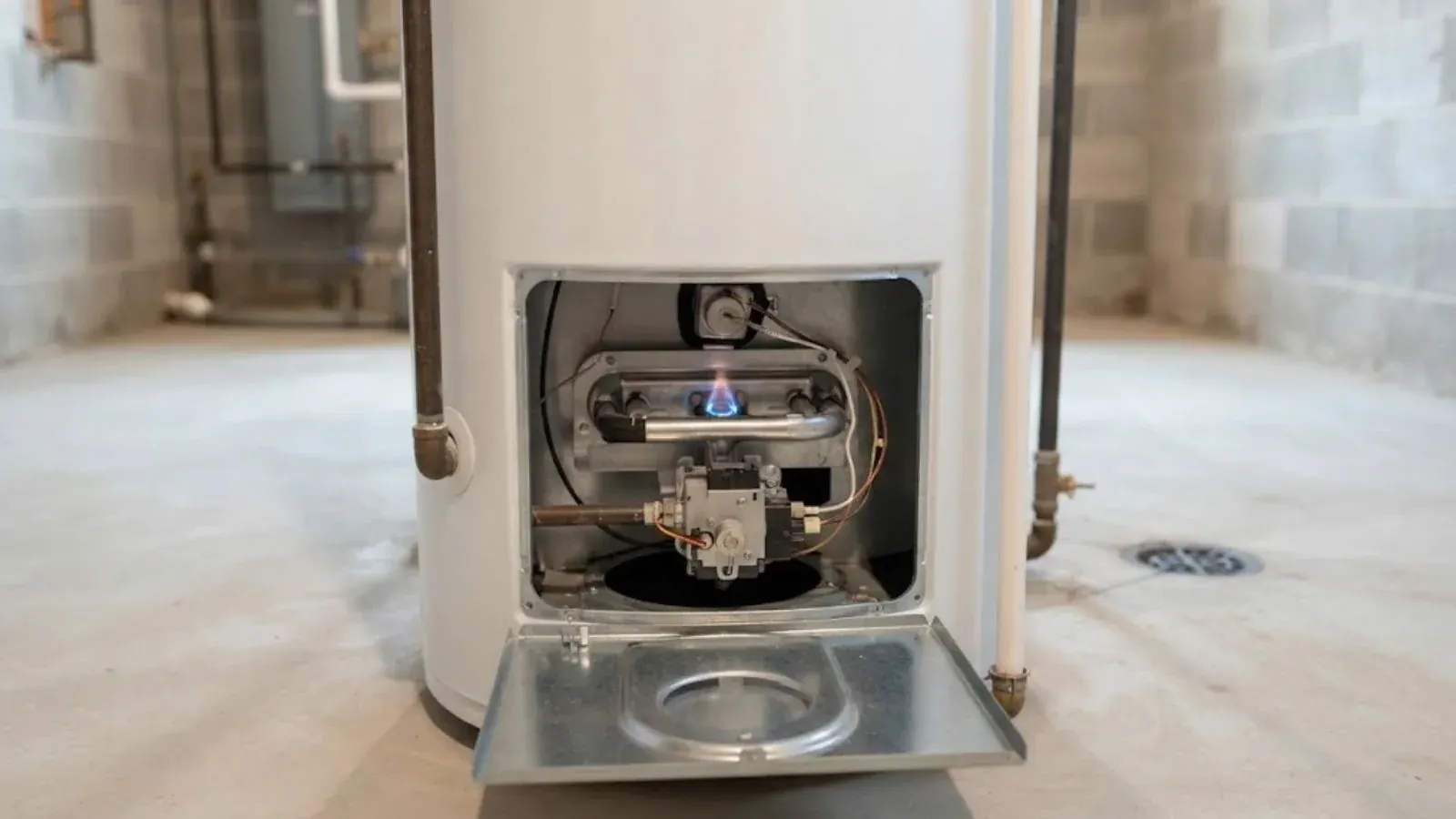
When a water heater problem is an emergency
A water heater that leaks from the tank body, from the relief valve discharge, or from a fitting can empty a tank onto a finished floor in minutes. Shut the cold water supply valve on top of the heater, switch off the breaker or turn the gas control to pilot, and run a hot tap to relieve pressure. Then call the 24/7 line.
A heater with no hot water at all is urgent but usually not a flood risk. Check the breaker or pilot light first. A reset that works once and fails again tells the plumber something specific about the element, thermostat or burner.
Gas smell or scorched wires
If you smell gas, leave the building and call the gas utility or 911 before you call us. If you see scorching or melted insulation at an electric heater, switch off its breaker and keep clear. These are safety problems first and repair problems second.
Leaks from the tank or connections
Where the water appears matters. A drip at the top is often a loose fitting or a failed connector, and it is a simple repair. Water from the relief valve line can mean excess pressure or a valve that has worn out. Water seeping from the bottom of the tank jacket usually means the tank itself has corroded through, and repair is not possible.
When the tank is the source, the honest advice is replacement. Our water heater replacement page covers sizing, and many leak calls end there rather than in a repair.
No hot water, lukewarm water and rumbling noises
Electric tanks lose heat when an element burns out, a thermostat sticks or a reset trips. Gas tanks lose it when the thermocouple fails, the burner clogs or the gas control stops opening. Lukewarm water often means one of two electric elements has quit. Rumbling and popping come from sediment on the tank floor.
The older the tank, the more likely sediment, a spent anode rod and general wear are all in play together. We tell you plainly when a repair makes sense and when it is money spent on a tank near the end of its life.
| Symptom | Common cause | Typical outcome |
|---|---|---|
| Cold water only | Failed element, thermostat, thermocouple or gas control | Repair |
| Lukewarm, runs out fast | One of two elements failed, or heavy sediment | Repair or flush |
| Rumbling or popping | Sediment hardening on the tank floor | Flush, or replace if old |
| Water around the base | Tank corrosion or a failed fitting | Replace if the tank body leaks |
| Relief valve dripping | High pressure, thermal expansion or a worn valve | Repair after a pressure check |
Tankless, hybrid, electric and gas units
Repair differs by type. Tankless units fail from scale in the heat exchanger, venting faults and flow sensor errors, and many need a flush. Hybrid heat pump models add a compressor and fan, plus a condensate drain that can clog. Our tankless water heater page covers flushing and descaling in more depth.
Gas models need correct venting and combustion air, and any gas work is done with safety first. If your gas heater is repeatedly going out, call rather than relighting it over and over.
West Linn water is soft, which changes the usual advice
The city's 2024 water quality report lists hardness at 36 parts per million, about 2.1 grains per gallon. Hard water builds scale on elements and heat exchangers, and West Linn has much less of that than many cities. It does not mean tanks last forever, but sediment buildup tends to be slower than the national picture suggests.
The report also notes that corrosion of household plumbing is a typical source of lead and copper. If your heater connections are old galvanized or corroded copper, repair visits are a good time to ask the plumber what your water lines are made of.
Source type: City of West Linn annual water quality report (2024 data)
What affects the cost of water heater repair
- Part that failedAn element or thermostat is a small repair, a gas control or heat exchanger is a larger one.
- Age of the heaterA repair on a tank near the end of its life may not be the best use of money.
- Fuel and typeTank, tankless, hybrid, gas and electric each have different parts and labor.
- LocationA garage or utility closet is easier than a tight attic or crawlspace.
- Time of dayAfter-hours dispatch costs differently from a scheduled visit.
A leak that damages the home is usually handled as a sudden damage claim, while wear and tear on the heater is typically not covered. Ask your insurer which applies. Want your real number? Call (503) 974-3329.
Work on water heater repair falls under the Oregon Plumbing Specialty Code, the state plumbing code, which is based on the Uniform Plumbing Code (UPC). Which rules apply to your job, and whether a permit is needed, is a question for the plumber and for the City of West Linn Building Division at 503-656-4211.
Cold shower or a wet floor? Call the 24/7 water heater line.
Call (503) 974-3329If you are planning ahead rather than reacting, water heater installation covers relocation and upgrades, and leak detection covers the case where water around the heater is not coming from the heater at all.
Common questions about water heater repair in West Linn
Yes. A leaking tank cannot wait until Monday, so the line is open 24/7. Shut off the cold water supply and the power or gas, then call (503) 974-3329.
Often not, if the tank itself is leaking or the heater is well past its expected life. A failed element or thermostat on a younger tank is a good repair. The plumber gives you both options with prices.
Sediment collects on the bottom of the tank and traps water that boils under it. Flushing helps on a younger tank. On an old tank, the sediment layer is usually a sign to plan for replacement.
Yes, including flushing, descaling, venting corrections and sensor repairs. Error codes help, and the plumber confirms the cause before ordering parts.
West Linn's 2024 report lists hardness at 36 parts per million, which is soft. Scale is less of a concern here than in hard-water cities, but sediment, corrosion and age still wear tanks out.
Leave the building, do not touch switches, and call the gas utility or 911 first. Call a plumber only once the utility says it is safe.
No hot water or a leaking tank in West Linn? We answer day or night.
Call (503) 974-3329