
When a clogged drain is an emergency
Most clogs are annoying but slow. A clog becomes an emergency when water has nowhere to go: a toilet overflowing onto a floor, a tub filling while the sink gurgles, or a floor drain in the basement bubbling up. Those signs usually mean the blockage is in the main line, not in a single fixture.
If more than one fixture is affected, assume the main line. Do not run the dishwasher or washing machine to "test" it, because every gallon you add has to go somewhere. Open a window if there is a sewage smell, and keep children and pets out of the affected room.
What to do while you wait for the plumber
These steps limit the mess and make the repair faster.
- Stop all water use in the house until the line is cleared.
- Move rugs and belongings away from the lowest drain, usually a basement floor drain or a ground-floor tub.
- Do not pour chemical drain cleaner into a standing blockage. It sits in the pipe and can burn the technician working on it.
- Note which fixtures are slow and which are fully blocked, so the plumber can narrow down where the clog sits.
Kitchen sink clogs
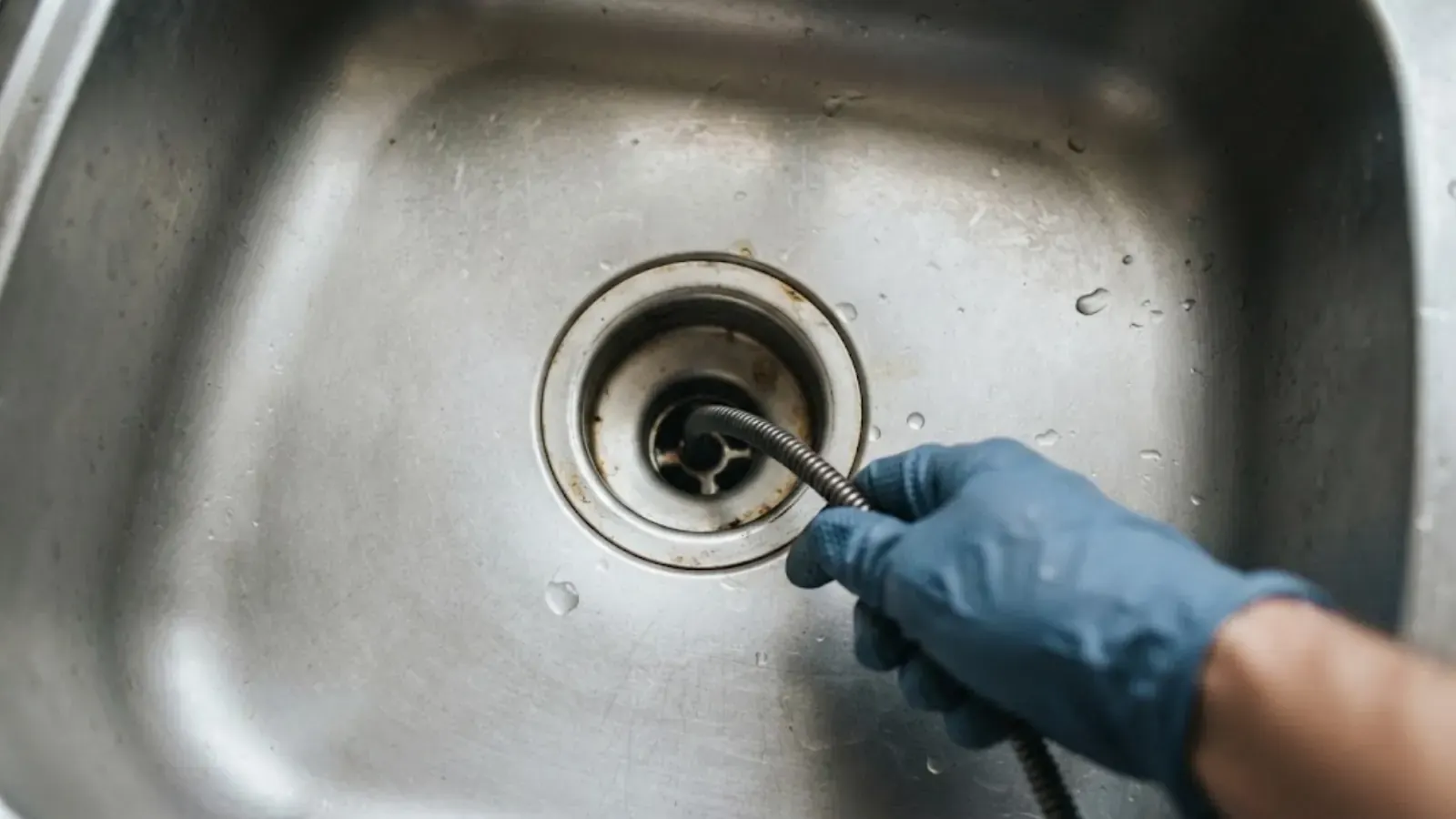
Kitchen drains clog with grease, food solids and soap residue that coat the pipe a little more each week. The sink drains slowly for a month, then stops. A plunger helps with a fresh clog, but a grease plug a few feet down the branch line needs a cable machine or, for heavy buildup, hydro jetting.
If a garbage disposal sits on the sink, the clog may be at the disposal outlet or the trap arm just past it. When the disposal hums but the water does not move, our garbage disposal repair page explains when the disposal itself is the problem.
Shower, tub and bathroom drains
Hair and soap scum build a mat just below the drain opening, and in older homes the tub trap collects more of it. A drain that empties slowly in the shower is a warning sign, not a nuisance. Pulling the hair mat by hand often gives temporary relief, and snaking the trap clears the rest.
A toilet that bubbles when the shower drains is a different story. That pattern points to the branch or main line, and it is worth calling the same day.
Snaking, cabling and jetting: which one fits
| Method | Best for | Limit |
|---|---|---|
| Hand auger or snake | Single fixture clogs, hair, small obstructions | Punches a hole in grease instead of removing it |
| Cable machine | Main line clogs, roots, longer runs | Leaves heavy scale on pipe walls |
| Hydro jetting | Grease, scale, silt and root fibers | Needs a sound pipe, so a camera check comes first |
| Camera inspection | Repeat clogs and unknown causes | Finds the cause, does not clear it by itself |
A drain that clogs again within a few months has a cause the cleaning did not remove. A bellied section, a root intrusion at a joint or a cracked clay tile will keep catching waste. That is when a sewer camera inspection pays for itself, and it is why we describe what the camera shows before recommending a repair.
Older West Linn homes and why their drains clog
A city survey of the Bolton neighborhood recorded 418 older properties, and 250 of them were built in the 1950s and 1960s. Sunset has a similar mix, with 63 properties from the 1950s and 48 from the 1940s. Houses of that age often have long, shallow-pitched branch lines and several decades of grease and root pressure behind them.
In practice, that means a West Linn main line backup in these neighborhoods is worth a camera look after the first cleaning, so you know whether the cause was a one-time clog or a failing section. Many older lines also pass under mature trees, so root growth near joints is a regular finding.
Source type: City of West Linn Bolton and Sunset historic resource survey
What affects the cost of drain cleaning
- Where the clog sitsA fixture trap is a short job. A main line cleanout takes more time and equipment.
- Method requiredSnaking, cabling and jetting use different equipment and time.
- AccessA working cleanout speeds things up. Without one, the plumber may have to go through a toilet or roof vent.
- Camera follow-upA recording shows the cause and is a separate step from clearing the line.
- Time of dayNight and holiday dispatch is priced differently from a scheduled visit.
Most homeowner policies cover sudden water damage but not the cost of clearing a clog, and sewer backup coverage is often an optional add-on. Ask your insurer before the bill arrives. Want your real number? Call (503) 974-3329.
Work on drain cleaning falls under the Oregon Plumbing Specialty Code, the state plumbing code, which is based on the Uniform Plumbing Code (UPC). Which rules apply to your job, and whether a permit is needed, is a question for the plumber and for the City of West Linn Building Division at 503-656-4211.
Drain backing up right now? Call for 24/7 drain cleaning in West Linn.
Call (503) 974-3329For stubborn main line problems we may recommend sewer line cleaning or a longer-term fix through sewer line repair. Neighbors in Oregon City and Gladstone reach the same dispatch line for drain work.
Common questions about drain cleaning in West Linn
Yes. Drain emergencies do not keep office hours, so the line is open 24/7, including holidays. Call (503) 974-3329, stop using water, and the plumber will start with the main line if more than one fixture is affected.
A repeat clog usually means something is catching waste further down, such as grease scale, roots at a joint, or a sagging section of pipe. A camera inspection shows which one it is.
Chemical cleaners can damage older metal pipes and leave caustic liquid in the line, which is a hazard for the plumber. Cable or jetting clears the clog without that risk.
Yes, when the method matches the pipe. Cables are fine for most lines, and jetting is chosen only after a camera confirms the pipe can take it.
If a toilet, tub and floor drain all act up together, or a drain gurgles when another fixture runs, the main line is the likely cause. A single slow fixture is usually a branch clog.
Yes. We work across every West Linn neighborhood, including Bolton, Willamette, Sunset, Robinwood, Hidden Springs and Savanna Oaks.
Backed-up drain in West Linn? A dispatcher answers day or night.
Call (503) 974-3329