
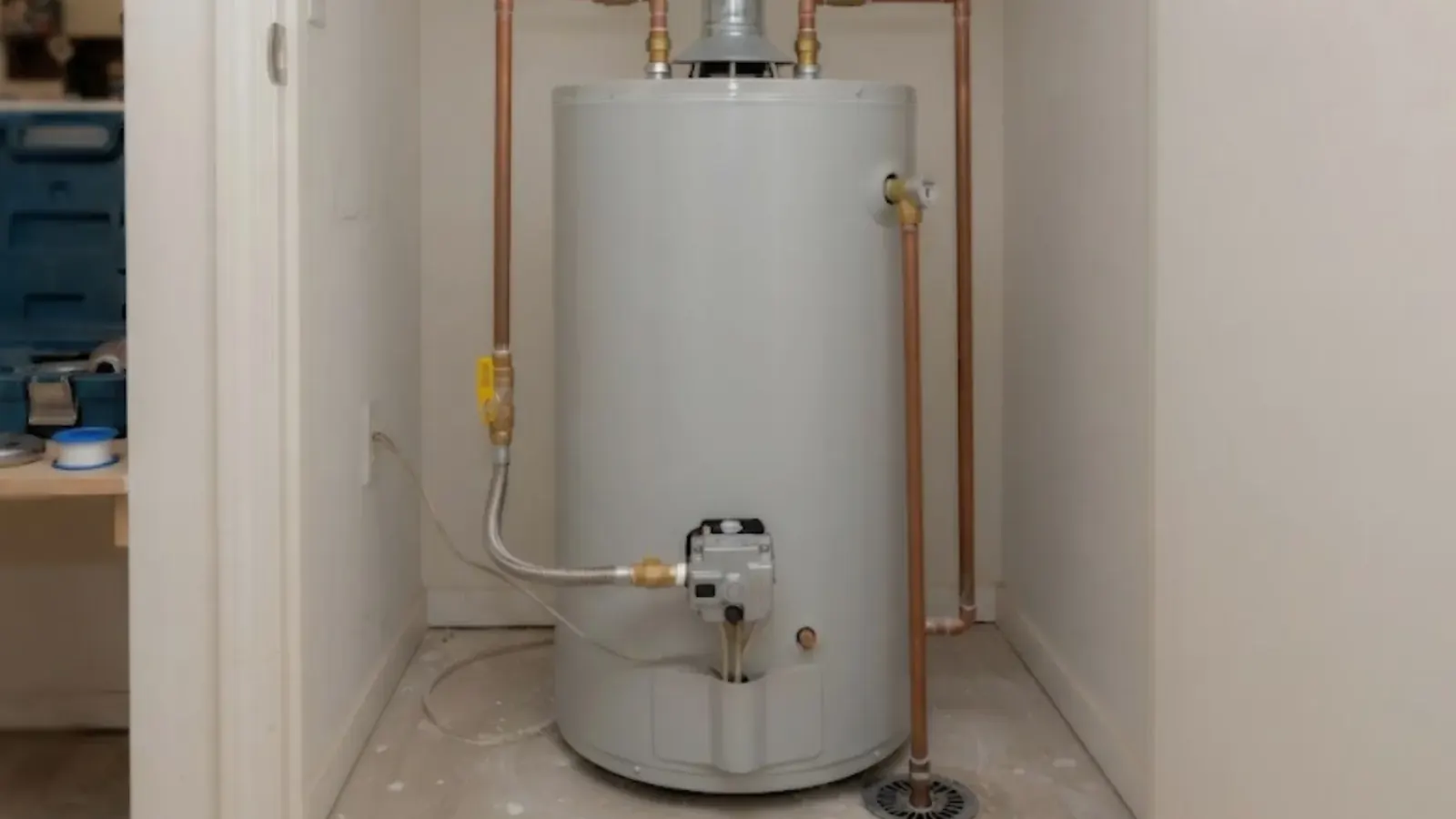
Planning the installation
A planned install gives you the one thing an emergency never does: time to choose. Start with how much hot water the household uses at the same moment. Two showers and a dishwasher running together is a different load from one person on a weekday morning.
Then look at where the heater sits. A garage, a utility closet and a crawlspace each affect what can be installed and how much work is involved. Venting, drain access and clearance for service are as important as the tank size.
| Option | What changes | Good for |
|---|---|---|
| Same-size tank swap | Almost nothing, fastest path | Replacing an aging tank on a schedule |
| Larger tank | Space, strapping, sometimes a larger circuit or gas line | Growing households |
| Hybrid heat pump | Clearance, condensate drain, electrical circuit | Lower electric bills |
| Tankless | Gas capacity or high amperage, venting, wall mounting | Space savings, continuous hot water |
| Relocation | New supply, drain, vent and power routing | Remodels and additions |
Gas, electric and hybrid installs
Gas heaters need correct venting and combustion air, a proper gas connection and a drip leg, and the plumber tests every joint for leaks before the unit is put to work. Electric heaters need the right circuit and disconnect, and the breaker rating must match the heater.
Hybrid heat pump models pull heat from the surrounding air, so the room needs enough volume and airflow. They are loud enough that you will notice one near a bedroom wall. A condensate line has to run to a drain or pump.
What to have ready before an install visit
A few details help the plumber quote accurately before arriving.
- Photo of the old heater label showing capacity, fuel and model.
- Where the heater sits: garage, closet, attic or crawlspace.
- Whether the home uses gas, electric or both.
- Any plans for a remodel that may change plumbing in the next year.
Expansion tanks, relief valves and safety parts
A closed plumbing system needs a place for expanding hot water to go. Where the water supply has a backflow preventer or pressure regulator, an expansion tank is usually part of the installation. The temperature and pressure relief valve and its discharge line are safety parts and are installed or replaced with the heater.
Seismic strapping keeps a tank from tipping, which matters in Oregon. The plumber checks local requirements and installs the strap kit when the installation calls for it.
Permits and codes for an installation in West Linn
Permit rules vary, so ask the City of West Linn Building Division what applies to your address. Oregon's plumbing code is the Oregon Plumbing Specialty Code, which is based on the Uniform Plumbing Code. Work in Oregon has to be done by people authorized by law, and contractors need both a Construction Contractors Board license and the matching Building Codes Division plumbing contractor license.
Both agencies offer an online license search, and it takes a minute to check any plumber you hire, including us. Savanna Oaks and other newer West Linn homes often have garage or closet heater locations that are easy to work with, while older homes in Bolton and Willamette may need venting or access corrections.
Source type: Oregon Building Codes Division and Oregon Construction Contractors Board licensing pages, City of West Linn Building Division
What affects the cost of installation
- Unit type and sizeTank, hybrid and tankless units cover a wide spread.
- Fuel and capacityGas line size, venting and electrical circuits can add scope.
- Location and accessAttics and crawlspaces take more time than a garage.
- Code upgradesExpansion tank, strapping, venting and relief valve discharge affect the total.
- Removal of the old unitHauling and disposal are part of the job.
Planned installs are not an insurance event, so there is no claim to file. The upside is that you can compare options and schedule the job when it suits you. Want your real number? Call (503) 974-3329.
What to do before installation day
Do these while help is on the way.
- Clear a path to the heater and a few feet of working room around it.
- Note where the main water valve and the gas shutoff are.
- Ask whether a permit and inspection are part of the quote.
- Plan for the water to be off for a few hours.
- If you smell gas at any time, leave the house and call the gas utility from outside.
Work on water heater installation falls under the Oregon Plumbing Specialty Code, the state plumbing code, which is based on the Uniform Plumbing Code (UPC). Which rules apply to your job, and whether a permit is needed, is a question for the plumber and for the City of West Linn Building Division at 503-656-4211.
Ready to schedule a water heater install? Call and book a window.
Call (503) 974-3329If your current unit still works but is aging, our water heater repair page explains when to repair and when to replace. Homeowners in Oregon City and Lake Oswego use the same service.
Common questions about water heater installation in West Linn
A like-for-like swap is often a half-day job. Relocations, new venting, gas line work and tankless conversions take longer, and the plumber tells you before work begins.
Yes. Each location has requirements for clearance, venting and drain access, and the plumber confirms them before quoting.
Only if the old one ran out of hot water regularly. A dispatcher can ask a few questions about your household and recommend a size.
It depends on your gas supply, venting and hot water use. West Linn's soft water means less scale on the heat exchanger than in hard-water cities, but annual flushing is still recommended by most manufacturers.
Space, airflow and a condensate drain. It also needs a 240 volt circuit in most homes, which the plumber or an electrician confirms.
Yes. The line is open 24/7 and same-day appointments are available when the schedule allows.
Planning a new water heater in West Linn? Call and get a clear price first.
Call (503) 974-3329