
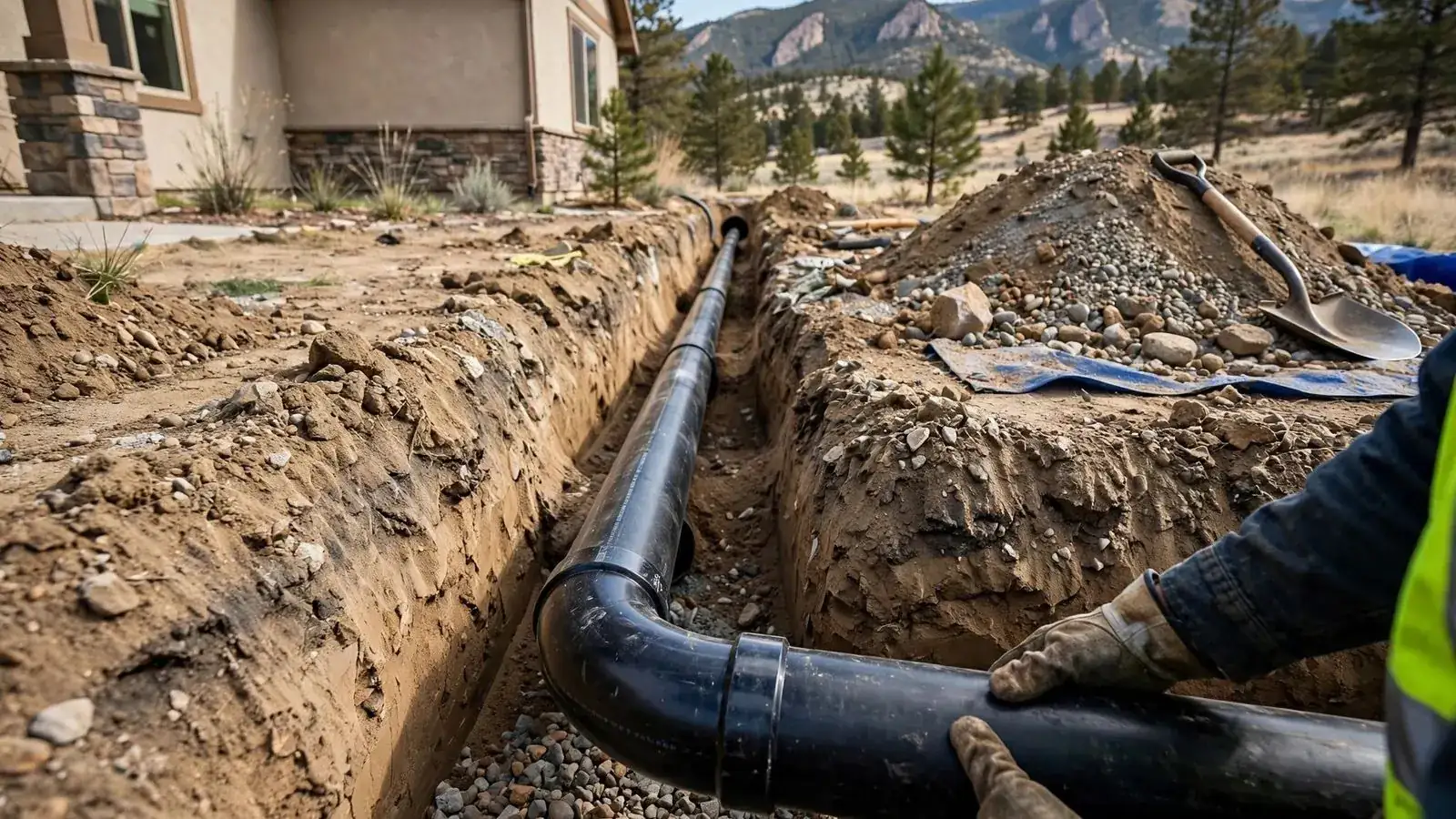
Sewer backup: what to do first
If sewage is coming up from a floor drain, a tub or a toilet, treat it as a health problem as well as a plumbing problem. Stop running water, keep children and pets away, and avoid touching the water with bare hands. Open windows if the smell is strong.
Do not use chemical cleaners on a main line backup. They do not clear a failed pipe, and they put caustic liquid in front of the technician. If the backup happened after heavy rain, the cause may be the municipal line rather than your lateral, and the plumber can tell the difference with a camera.
What causes sewer line damage
The usual causes are root intrusion, bellied sections that hold water, cracked or collapsed pipe, offset joints and old pipe material that has reached the end of its life. Roots enter at joints and cracks in search of moisture, then grow into a mat that catches paper and grease.
Cast iron lines rust from the inside and flake, which narrows the pipe and eventually breaks it. Clay tile lines come apart at joints. Fiber conduit known as Orangeburg softens and deforms. A camera inspection shows which material you have and what shape it is in.
Sewer backup is an emergency when
Sewage is rising in a tub or floor drain, several fixtures back up together, you smell sewage inside, or water is standing in a basement. Stop water use and call the 24/7 line. If anyone has contact with sewage, wash thoroughly and keep wounds covered.
| Option | How it works | Best fit |
|---|---|---|
| Spot repair | Dig down and replace a short failed section | One defect in an otherwise sound line |
| Trenchless pipe lining | A resin liner cures inside the old pipe | Cracks and root entry with a mostly intact pipe |
| Pipe bursting | A new pipe pulls through while the old one fractures | Collapsed or heavily failed runs |
| Full replacement | Open trench and install new pipe | Severe damage or a line that will not support lining |
Trenchless pipe lining and when it works
Pipe lining is a repair for lines that are damaged but still hold their shape. A resin-soaked liner is pulled into the pipe and cured to form a new pipe inside the old one. It avoids trenching through landscaping and driveways and can be faster than excavation.
It is not right for every pipe. A collapsed section or a line with significant bellies will not line well, and the camera decides. We describe the camera findings plainly before recommending a repair, and we are clear when digging is the better choice.
Cast iron sewer pipe repair
Cast iron drains and sewer sections in older homes often fail at the bottom of the pipe, where waste sits. The inside rusts into a rough scale, and the pipe may look fine on the outside. Repair options include replacing the bad section with modern pipe or lining it when the pipe is still sound.
If a cleaning only gives temporary relief, the next step is a sewer camera inspection and a repair plan. For the cleaning itself, our sewer line cleaning page covers cable and jetting.
Sewer lines in older West Linn neighborhoods
The City of West Linn history page notes that the population grew from 2,923 in 1960 to over 7,000 by 1970. A city survey found 130 properties from the 1960s and 120 from the 1950s in Bolton alone. Many sewer laterals in those streets date from that boom and have decades of root pressure behind them.
Where the city's sewer responsibility ends and yours begins varies by address, so ask the City of West Linn public works office before you dig. Permit rules vary, so ask the City of West Linn Building Division before any excavation. Properties near mature trees along Willamette Drive and in Robinwood see root intrusion regularly.
Source type: City of West Linn history page and Bolton historic resource survey
City sewer or septic: know which you have
The City of West Linn operates 115 miles of sewer lines, according to its public works page. If your property connects to one of them, your lateral runs to the city main. If it does not, it likely has a septic system, and the plumbing inside the house is handled the same way, while the tank and drain field are a separate specialty.
Not sure which you have? Look for a cleanout and a tank lid in the yard, or ask Public Works Operations at 503-722-5500. A camera look through sewer inspection shows what the lateral connects to.
What affects the cost of sewer repair
- Damage typeA short spot repair, a lined run and a full replacement are very different totals.
- Length and depthLonger, deeper lines take more time and equipment.
- Pipe materialCast iron, clay and Orangeburg each carry their own conditions.
- Surface restorationDriveways, landscaping and fences affect scope for open-trench work.
- Permits and inspectionPermit rules vary, so check with the building division.
Sewer backup coverage is often an optional endorsement on a homeowner policy, and the repair of a failing line is usually treated as maintenance, not damage. Ask your insurer before work begins. Want your real number? Call (503) 974-3329.
Work on sewer line repair falls under the Oregon Plumbing Specialty Code, the state plumbing code, which is based on the Uniform Plumbing Code (UPC). Which rules apply to your job, and whether a permit is needed, is a question for the plumber and for the City of West Linn Building Division at 503-656-4211.
Sewage coming up? Stop water use and call the 24/7 sewer line.
Call (503) 974-3329After a repair, a hydro jetting pass can clear remaining scale. Neighbors in Oregon City and Gladstone reach the same dispatch line for sewer work.
Common questions about sewer line repair in West Linn
Yes. Sewage in the house cannot wait, so the line is open 24/7. Stop using water and call (503) 974-3329.
Repeat main line clogs, gurgling drains, sewage smell, soggy yard spots and slow drains in several fixtures all point to the line. A camera shows the actual condition.
No. It works when the pipe holds its shape. Collapsed sections and deep bellies often need digging, and the camera tells which applies.
It varies by address. Ask the City of West Linn public works office where the city's responsibility ends before spending money on a repair.
They find cracks and open joints and grow inside, which widens the opening over time. Cleaning clears the roots, and a repair closes the opening.
It shows pipe material, cracks, roots, offsets, bellies and the location of problems. See the sewer inspection page for details.
Sewer backup in West Linn? Stop water use and call, day or night.
Call (503) 974-3329