
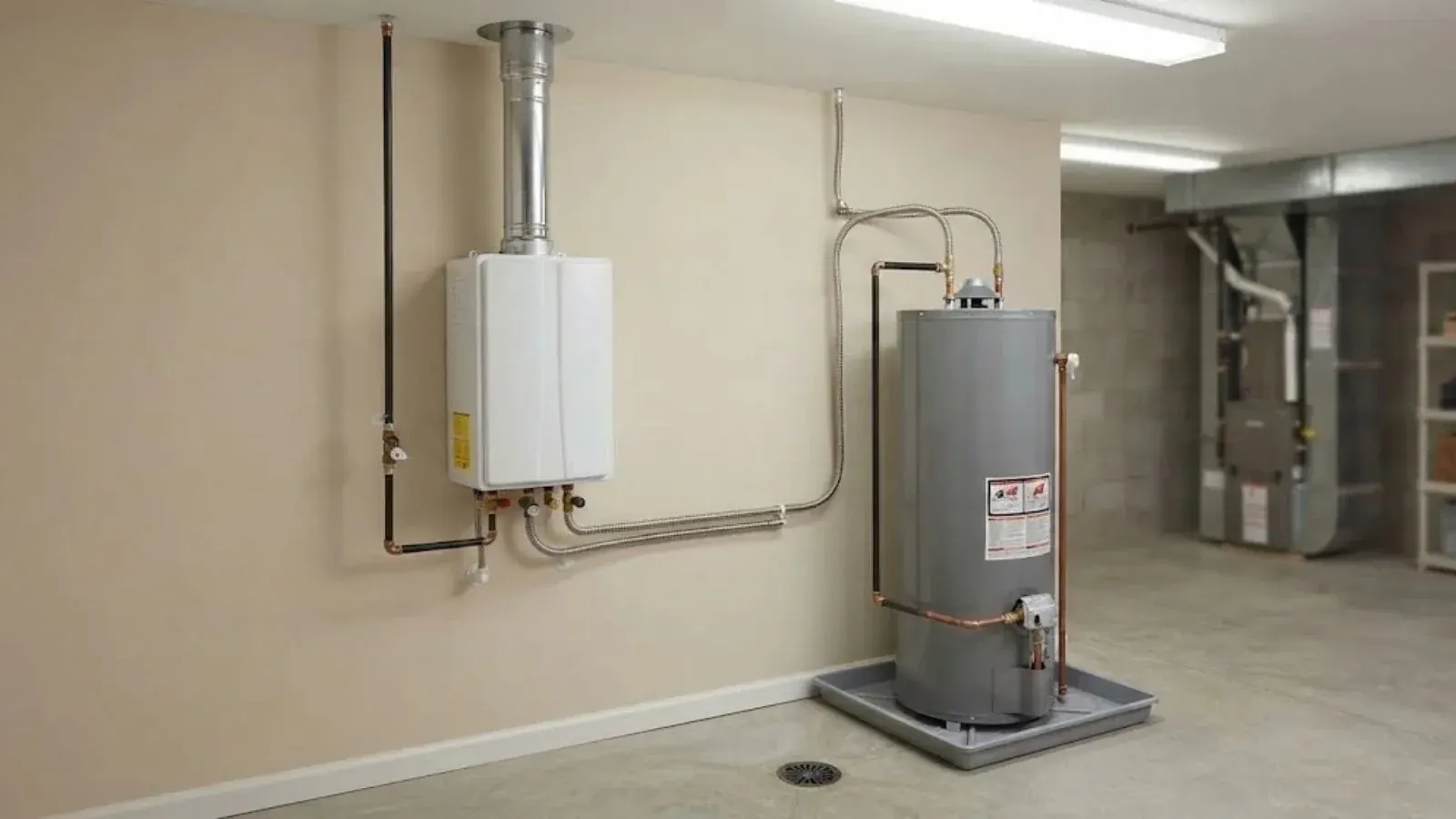
What actually changes when you go tankless
A tank heater stores forty or fifty gallons and keeps it warm. A tankless unit fires only when you open a tap, then heats the flow on the way through. That removes standby heat loss and gives you hot water as long as the unit can keep up.
The trade is capacity. A tankless unit has a maximum flow rate at a given temperature rise, so two showers and a dishwasher at once may stretch a small one. Sizing by the number of fixtures you run together is the first conversation.
| Factor | Tank heater | Tankless heater |
|---|---|---|
| Hot water supply | Limited by tank size | Continuous, limited by flow rate |
| Space | Floor space, tall | Wall mounted, compact |
| Gas or power | Standard supply | Often a larger gas line or higher amperage |
| Venting | Draft hood or power vent | Sealed venting, often through a wall |
| Maintenance | Flush the tank | Periodic descaling and filter cleaning |
The retrofit questions that decide the project
Ask these before you commit
They determine the price more than the unit does.
- Is the existing gas line big enough, or does it need to be upsized?
- Where will the venting exit the house?
- Is there a condensate drain nearby for a high efficiency unit?
- Is the electrical supply adequate for the controls or an electric unit?
- Where will the unit mount, and is it reachable for service?
A tankless unit often moves from the floor to a wall, and that means new gas, new vent and new water connections. In older houses the gas meter and the line from it can be the limiting factor. A good plumber looks at those before quoting.
Soft water helps a tankless heater
Scale is the main enemy of a tankless heat exchanger. Hard minerals bake onto the exchanger and reduce flow and efficiency. Soft water slows that process, and so the maintenance interval is longer than it would be in a hard water city.
It does not eliminate maintenance. The manufacturer will still call for periodic flushing, and the inlet filter needs cleaning. Our tankless water heater page covers the service side.
What West Linn's water report says about your supply
The City of West Linn's 2024 water quality report describes the water as soft and lists hardness at 36.0 ppm, alkalinity at 40 ppm and total dissolved solids at 60 ppm, against a secondary standard of 500 ppm. The water comes from the lower Clackamas River, treated at the South Fork Water Board plant.
For a tankless buyer, those numbers mean a slow scaling rate, which protects the heat exchanger and keeps the unit efficient. You still want a service plan, but you are unlikely to need a softener just to protect the heater. The report is your source, and the city lists a Public Works contact in it if you have a specific question.
Source type: City of West Linn annual water quality report (2024 data)
Cost, incentives and timing
A tankless installation costs more than a tank swap, mainly because of the gas line, the venting and the wall mounting. Ask for an itemized price and ask which parts are the unit and which are the retrofit work.
Some utilities and manufacturers offer rebates. Ask your utility and the manufacturer, and do not assume. Also ask the plumber about the permit, since the City of West Linn Building Division at 503-656-4211 answers what applies to your job.
Calls from nearby towns
Homeowners in Lake Oswego and Tualatin ask the same question, and the planning steps are identical. Tualatin buys soft Bull Run water from Portland, so scale is a small factor there as well. If you are replacing a failed tank, the water heater replacement page shows the quick route back to hot water while you plan.
Living with a tankless heater day to day
The first thing most people notice is the short delay before hot water arrives, since the unit has to fire and the pipes still hold cool water. A recirculation line or a small buffer tank can shorten that wait, and your plumber can tell you whether it is worth adding.
The second is the cold water sandwich, a brief burst of cool water between two hot draws. It is a normal behavior of many models and not a defect. Ask the installer how your model handles it.
Tankless units also need a power source for the controls, so a power outage can leave you without hot water even on a gas model. If your area loses power in winter storms, ask about a battery backup or plan for it.
Plumbing work in Oregon follows the Oregon Plumbing Specialty Code, which is based on the Uniform Plumbing Code (UPC). This guide is general information. For your own house, ask the plumber which rules apply and check permits with the City of West Linn Building Division.
West Linn questions on this topic
Often it needs a larger line. The plumber measures the run and the demand before quoting.
No. The city's 2024 report lists soft water at 36.0 ppm hardness, which slows scale.
Usually not. Tankless units use different venting, and the plumber will plan the exit route.
Many installations take most of a day, longer if the gas line or venting needs extensive work.
Often yes. Ask the City of West Linn Building Division at 503-656-4211, and the plumber can explain the steps.
Ready to compare tank and tankless for your home? Call to plan it.
Call (503) 974-3329