
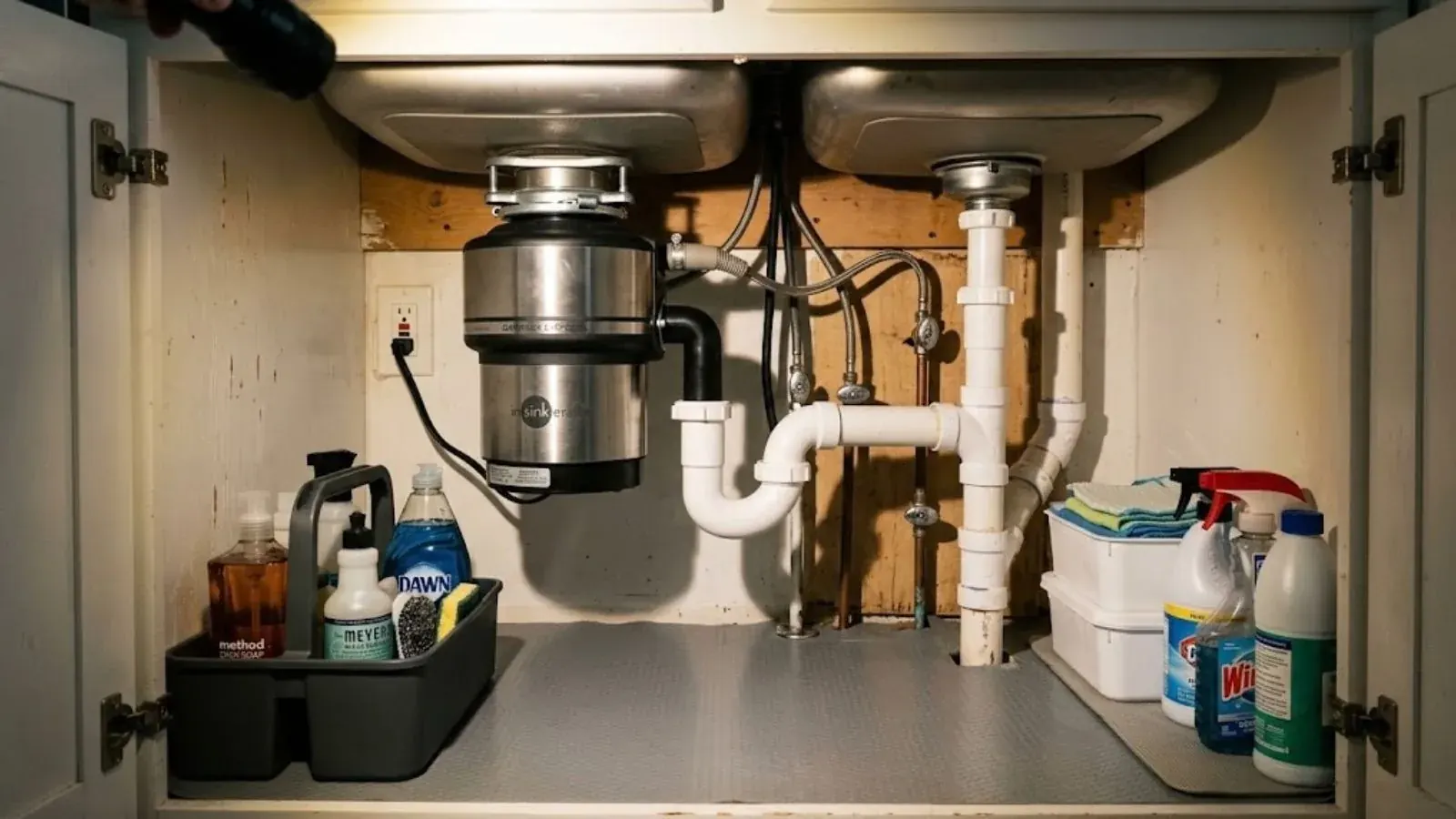
Choosing a disposal that fits your kitchen
Horsepower is the usual spec. A smaller motor handles light use, while a larger motor grinds tougher scraps and runs more quietly. Feed type matters too. A continuous feed unit runs while you push scraps in. A batch feed unit runs only when a cover is in place, which is safer for homes with children.
Check the sink. Most stainless and many composite sinks have a standard three-bolt opening, but a few designs need an adapter. A plumber checks the opening and the drain layout before you buy.
| How you cook | Good fit |
|---|---|
| Light use, small household | Smaller continuous feed unit |
| Busy family kitchen | Mid to large motor with a good insulation package |
| Young children at home | Batch feed unit |
| Septic or special plumbing | Ask the plumber first |
What installation involves
The installation steps
A plumber does these in order.
- Turn off power at the breaker and shut off water.
- Remove the old strainer and mount the new flange to the sink.
- Hang the disposal on the mounting ring and lock it in place.
- Connect the discharge to the trap, level and tight.
- Connect the dishwasher drain, after knocking out the plug in the inlet.
- Wire or plug in the power and run water to test for leaks.
The knockout plug is a step people miss. If the dishwasher connects to the disposal and the plug is still in place, the dishwasher will not drain. A plumber knows to remove it and clear the plug fragment from the chamber.
Electrical work
The disposal needs power from a switch or a switched outlet, usually under the sink. If there is no outlet, one has to be added, which may require an electrician. A plumber can tell you where the line is and who handles the circuit.
Never wire a disposal with the breaker on. A wrong connection can be dangerous.
What West Linn's sewer FAQ says about what leaves your kitchen
The City of West Linn's sewer FAQ states that non-biodegradable substances such as plastics, and toxic chemicals such as pesticides, gasoline, antifreeze and solvents, cannot be successfully treated by the sanitary system. The city's sanitary sewer page describes 115 miles of sewer lines and 10 pump stations including three shared Tri-City stations.
Practically, a disposal is not a trash can. Produce stickers, twist ties, rubber bands and bits of packaging are plastic, and they do not belong in the sink. Anything that cannot be treated ends up as a problem in your lateral or in a pump downstream. When in doubt, put it in the garbage.
Source type: City of West Linn sanitary sewer page and sewer FAQ
What a disposal can and cannot handle
Soft food scraps, small amounts of cooked food and citrus peels are fine with plenty of cold water. Fibrous vegetables such as celery stalks and corn husks, bones, fruit pits, coffee grounds in bulk, starchy rice and pasta, eggshell membranes and grease are poor choices. Grease coats the pipe downstream and combines with debris, so keep it out of the drain.
Run cold water for several seconds before, during and after grinding. Cold water keeps fats solid so they are chopped and carried away, where hot water melts them and lets them coat the line farther down.
Troubleshooting and when to call
A disposal that hums but does not grind is jammed. With the power off, turn the flywheel with a hex key and press the reset button. A disposal that leaks from the bottom has a failed housing or seal, and is usually replaced. See garbage disposal repair for the fix options.
If the sink drains slowly even with the disposal off, the clog is in the branch line, and drain cleaning is the next step.
Nearby towns we serve
Kitchen remodels in Oregon City and Lake Oswego often include a disposal, and the plumber coordinates with the electrician and the cabinet installer. Plan the disposal before the countertop goes in, since a sink cutout is hard to change later.
Noise, warranty and what to expect after the install
A well insulated disposal is noticeably quieter, and a rubber splash guard keeps scraps from flicking back. Ask for the warranty term on the motor and on labor, and keep the receipt. A new unit may hum for a moment on first use as the seals settle, which is normal.
Run the water for a full minute after the first few uses and check under the cabinet for drips. A damp towel on the cabinet floor overnight is a cheap leak detector.
Plumbing work in Oregon follows the Oregon Plumbing Specialty Code, which is based on the Uniform Plumbing Code (UPC). This guide is general information. For your own house, ask the plumber which rules apply and check permits with the City of West Linn Building Division.
West Linn questions on this topic
Many people do, but the electrical and drain connections need to be done correctly. A plumber ensures a leak-free install.
It needs power from a switch or a switched outlet. If one is not under the sink, an electrician may add it.
Grease, fibrous scraps, bones, pits, plastics and anything that is not food. West Linn's sewer FAQ says plastics cannot be treated.
The dishwasher knockout plug may still be in place. A plumber removes it.
It depends. Many septic systems are not designed for added food waste, so ask a plumber and your septic provider first.
Adding or replacing a kitchen disposal? Call for a clear price.
Call (503) 974-3329