
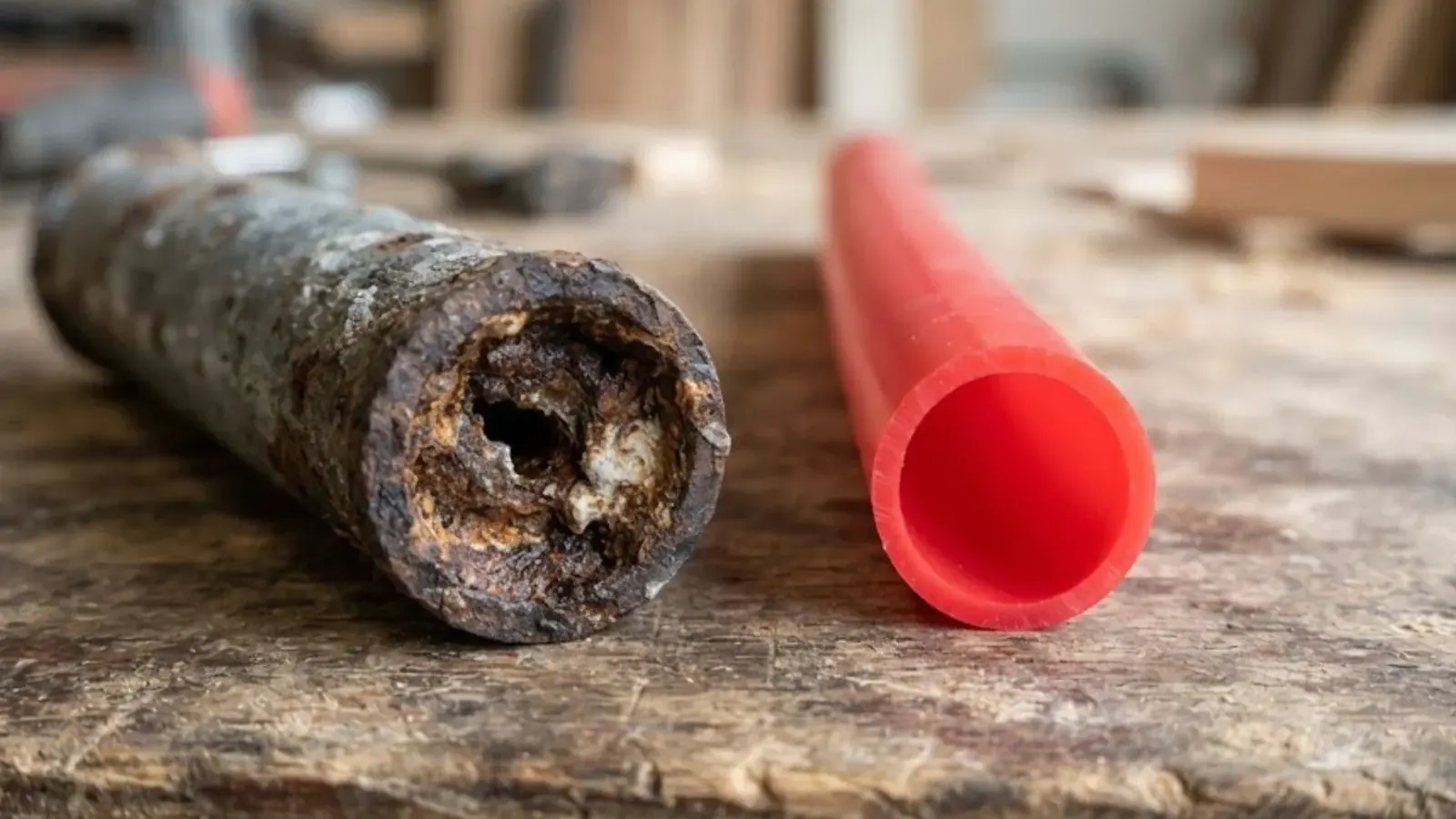
Why cast iron lasts and why it eventually fails
Cast iron is heavy and dense, so it muffles sound and resists impact. Its weakness is rust. Wastewater is acidic over time, and the inside of the pipe forms a rough layer of scale, called tuberculation. The layer narrows the pipe, catches debris and sheds flakes.
On the outside, moisture and soil attack the pipe. Cracks at joints, broken hub connections and holes at the bottom of horizontal runs are the usual failures.
Signs your cast iron drain is wearing out
Several together mean a closer look.
- Frequent slow drains that return after clearing.
- Rust colored water or flakes when you clear a line.
- Slow drains at several fixtures at once.
- Sewer smell in the basement or crawlspace.
- Visible rust, weeping joints or flaking on exposed pipe.
What a camera shows
A drain camera looks inside the pipe and shows the scale, the cracks and the joints. The plumber can tell whether the pipe still has a smooth bore or whether it is narrowed to half its diameter. A sewer camera inspection is the way to make this decision with evidence instead of guesses.
A camera also reveals whether the cast iron is the only problem. Many older houses have cast iron inside and clay or another material in the yard, and the trouble may be at the transition.
| Option | Good fit | Trade off |
|---|---|---|
| Cable or jet cleaning | Scale and buildup on sound pipe | Temporary, scale returns |
| Spot repair | One cracked or broken section | Other sections still aging |
| Pipe lining | Sound pipe with rough interior | Not for collapsed pipe |
| Replacement | Multiple failures or collapse | Most disruptive, longest lasting |
Cleaning cast iron: go gentle
Heavy cable cleaning on a thin, rusted pipe can punch through it. A plumber who sees the pipe on camera first can choose the right method. Hydro jetting scours scale without a spinning cutter, but on a pipe with weak spots it needs care.
Never use caustic drain chemicals on old cast iron. They sit in low spots, attack the pipe and are hazardous to handle.
How old are West Linn's houses, and what does that imply?
The City of West Linn's Bolton historic resource survey counts 130 properties built in the 1960s and 120 from the 1950s. The Sunset survey counts 252 older properties, including 63 from the 1950s and 48 from the 1940s. The city's history page shows population rising from 2,923 in 1960 to more than 7,000 in 1970.
Houses from those decades were plumbed when cast iron drains and galvanized supply lines were common. That does not mean every house has them, since many have been remodeled. It does mean a house from those neighborhoods is worth a camera look before you buy or remodel, since a cast iron stack or main could be original.
Source type: City of West Linn historic resource surveys (Bolton and Sunset) and city history page
Before a remodel or a sale
Adding a bathroom or replacing a kitchen drain is a good time to look at the old pipe it will tie into. If the main line is near the end of its life, replacing a section while walls are open costs less than reopening them later. Our sewer line repair page explains the repair side.
Homebuyers should ask for a camera on any house from the era. The recording shows the real condition and can support a repair credit in the negotiation.
Calls from nearby towns
Older homes in Oregon City and Gladstone have the same story. Clay lateral pipes and cast iron stacks show up in houses from the mid-century decades, and the camera is the same first step.
Reading the signs in a crawlspace or basement
You can learn a lot with a flashlight. Cast iron drain pipe is black or dark gray and heavy, with bell shaped hubs at the joints. Look for rust streaks, white mineral crust, wet spots under hubs and any place where a hanger has pulled loose. A tap with a screwdriver handle should ring dully, and a pipe that flakes or sounds hollow needs attention.
Take photos and share them with the plumber. If you can see sags between hangers or a joint that has shifted, say so, since those are common failure spots on an old horizontal run.
Plumbing work in Oregon follows the Oregon Plumbing Specialty Code, which is based on the Uniform Plumbing Code (UPC). This guide is general information. For your own house, ask the plumber which rules apply and check permits with the City of West Linn Building Division.
West Linn questions on this topic
Many decades, but it varies with water, soil and use. A camera shows the real condition.
Sometimes. Lining works on sound pipe with a rough interior, but not on a collapsed section.
No. It is a failing material, not a hazard, though a cracked drain can leak sewage and gas.
Many houses from the 1940s through the 1960s may, per the city's historic surveys. A camera confirms what your house has.
If the camera shows serious scale or cracks, planning a replacement during a remodel costs less than an emergency repair.
Own an older home in West Linn? Call to schedule a camera check.
Call (503) 974-3329